
Two years ago I made a call: AI would make it easy to create and maintain customised software at scale.
That one call had downstream effects on almost everything we do. It changed how we approach product building, how we shape the team, what our culture rewards and even how we sell. This post is about the engineering side of it and what we learned scaling the model for close to 2 years.
Customisation had a bad rep, and it earned it
Before AI, customisation and services businesses had a bad reputation. They are notoriously difficult to build and to scale, both as products and as businesses. Everything is constrained by humans: how many people you can hire, and how much context each of them can hold in their head. Every customer-specific feature is one more thing someone has to understand, build, test and then remember for as long as the customer stays.
Palantir cracked the code of deploying customised products at scale. But even they needed a standardised culture and processes internally to make it work. That is good, and I think it is where the buck will eventually go. As a startup, though, it has a high barrier to entry. You don't have the people, the years or the processes.
The question I asked myself
How can I operate like a startup and still do Palantir-style customisations across tech, product, pre-sales demos, pilots and deployments?
The answer was deceptively simple and partly well-timed. If we remove the need for humans to be the bottleneck, and if the software can maintain itself with high reliability, the model works for an early-stage startup too.
The bet: pool the customisations in one layer
Two years ago AI coding was picking up, but it was nowhere close to what it is today. At the end of 2026, fully autonomous software factories are deployed. Engineers are now agent managers rather than full-time coders. Mostly they don't even review the code: they check the plan and the outputs.
None of that existed when we made the call. What I had was one insight: if we pool the customisations in one layer of the stack and keep the rest of the code generic, then every incremental improvement in the models incrementally reduces the human context the customisation layer needs. We didn't need the models to be great on day one. We needed them to keep getting better, and we needed our code shaped so that each improvement paid off straight away.
That came with a belief I still hold strongly. A customisation we see twice, meaning two different customers or use cases ask for the same thing, goes into the generic product layer. If it doesn't fit there, we did not do a good job of abstracting it.
A harness before anyone called it one
Nobody was talking about harnesses two years ago, but that is what we ended up building: a common layer that can plug and play customisations for every customer and use case.
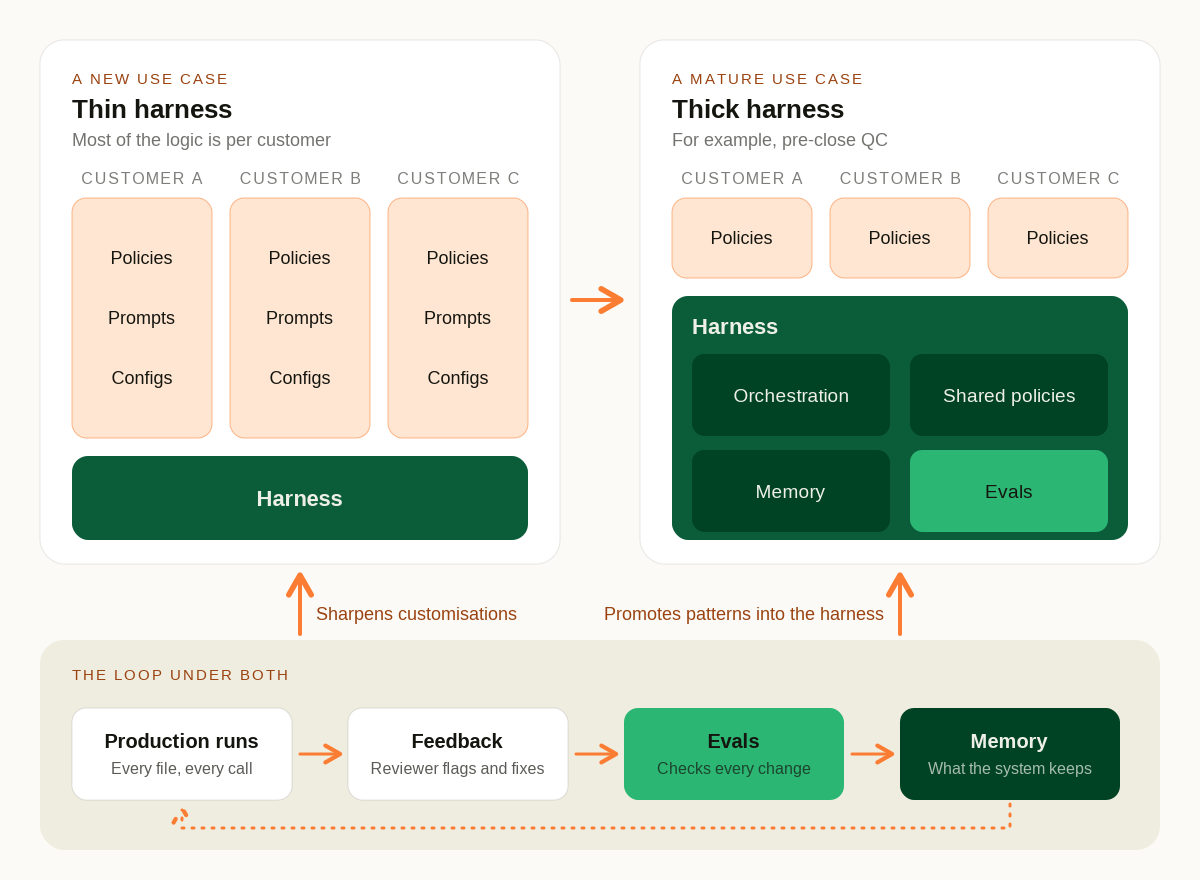
Customisations live as policies and configs, solved with prompts and code. The common layer orchestrates them. As long as we could move fast on the customisation layer, my bet was that the model would scale.
And scale, we did
We kept adding policies, prompts and configs for new customers and use cases, on a harness that was loose to begin with. Over time we saw patterns, and each pattern moved down a layer. The harness grew thicker and the policies grew thinner.
The job is not done. Newer use cases demand the same lifecycle: lots of customisation on a thin harness first, then slowly the other way round. But hey, a newer use case also means the product scope is expanding. We no longer serve piecemeal AI products for mortgage. We have a complete suite for every fragmented piece of the workflow.
But different parts of the platform are at different stages. Some are still early and need more customisation on a thinner harness. Others are much further along. Our pre-close QC AI, for example, has a much thicker harness, built from running on thousands of loan files every month and from the feedback on every one of them.
Evals are how you keep them
Customisation wins the deal. A customer sees their own rules, their own documents and their own edge cases handled in the demo and in the pilot, and that is what gets them to sign.
Keeping them is a different problem. Models change. Prompts get tuned. Policies move down into the harness. Every one of those changes can break something a customer relies on, and by design no human holds the whole picture in their head any more. That was the point of the bet, and it is also the risk.
This is where "software that maintains itself at high reliability" has to be more than a nice sentence. What holds it together is evals. The feedback from thousands of files a month turns into checks the system runs against every change. When a customisation moves into the harness, its checks move with it, so the generic version has to do at least as well as the custom one it replaces.
Without evals, a thick harness is just a bigger blast radius. With them, every customer we win makes the product better for the next one.
Customisation is how you win deals. Evals are how you keep them.
Written by
 Ramkumar VenkataramanCo-Founder and CTO